1 0 Archive | Oct 09, 2009, 7:51 pm
post icon

From the Wikipedia: Terror Birds!

By Ted Berg on Oct 09, 2009, 7:51 pm

Most of what’s published on TedQuarters will be about sports. But no more than once a day, you’ll have to indulge me and put up with a post that has nothing to do with sports. This is one of those posts.

I believe the Wikipedia is one of our greatest cultural achievements. And so in it’s honor, here’s the first of what I hope to become a quasi-regular series. It celebrates awesome things I find while surfing the Wikipedia.

From the Wikipedia: Terror Birds!

It’s a good thing evolution is based on survival of the fittest and not survival of the awesome. Otherwise, we wouldn’t be able to step outside without being menaced by these 10-foot-tall South American birds of prey from the Cenozoic Era.

Imagine looking out the window in the morning and seeing one of these hellbeasts thrashing your bird feeder. Then, for good measure, it could swallow your neighbor’s dog whole with its 18-inch beak.

Also, should you be so unfortunate as to piss a terror bird off, don’t expect to escape by foot, bike or Segway Human Transporter. These predators could run up to 30 miles per hour.

Look at that thing. You’re telling me this was somehow less fit for survival than the sparrow? Makes me dubious about this whole Darwinism concept.

post icon

A different reason to avoid Dan Uggla

By Ted Berg on Oct 09, 2009, 5:43 pm

Matt Cerrone from MetsBlog.com says he doesn’t think the Mets should sign Dan Uggla because of Uggla’s free-swinging ways.

While Matt’s right that Uggla is an unrepentant whiffer, he does manage to get on base adequately enough to be a valuable hitter. Uggla posted a .360 on-base percentage in 2008 and a .354 mark in 2009, so he is by no means Jeff Francoeur.

The problem is, he’s a bad defender by just about every standard. The Mets already have one of those at second base in Luis Castillo, so one could argue that Uggla’s offensive upgrade over Castillo — assuming it’s a wash defensively — makes him a nice fit for the Mets.

But with the team’s defense being as bad as it was, it’d be good to upgrade defensively if they were able to somehow move Castillo, especially if they hope to see some improvement out of ground-ball guy Mike Pelfrey.

The Mets seem more likely to acquire Uggla and move him to left field, but that would essentially sap him of his value by moving him away from a premium position. Because Uggla’s actually probably about 5’9″, tops (he’s listed at 5’11″), I’d be surprised if any team put him at first base.

Regardless, moving Uggla to any corner that’s not third base (which, in the Mets’ case, is occupied) makes him little more than a league-average hitter for the spot. Plus there are no guarantees he could field it adequately.

Granted, the 2009 Mets could have benefited from a few more league-average hitters, but not at the cost of the prospects it’ll take to acquire Uggla.

post icon

More of the same

By Ted Berg on Oct 09, 2009, 3:18 pm

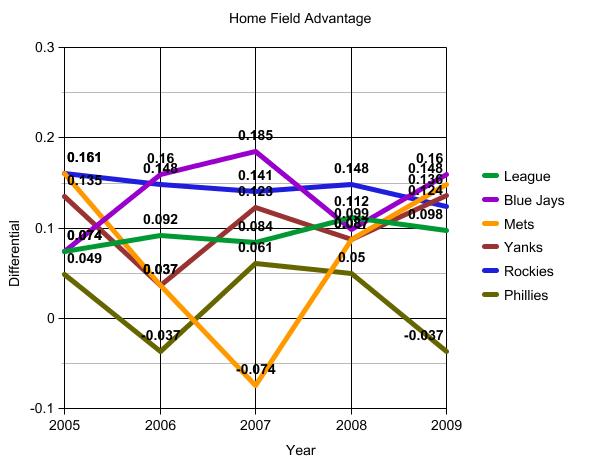
Here’s the third in this series. I picked the Blue Jays for Astroturf purposes, the Mets and Yanks because they’re the Mets and Yanks, and the Rockies and Phillies because of their noted hitter’s parks.

Looks like it’s just more noise.

Interestingly, the Rockies stayed above the league every single year. I wonder if the effects of altitude on the body, more than on the ball, could have something to do with that.

Hilariously, the Phillies were steadily below the league. That makes perfect sense, because everyone knows Phillies fans are miserable and don’t deserve to see a winning team.

The 2007 Mets were terrible at home, but the Mets otherwise fluctuated right around the mean. Same deal for the Yanks.

Graph!

There’s got to be a better way to quantify this, and a way to determine if it really exists. If anyone has any suggestions, I’m all ears. Just don’t make it too difficult on Jon T. Intern; he’s in college and should be having more fun.

post icon

More graphic fun

By Ted Berg on Oct 09, 2009, 2:03 pm

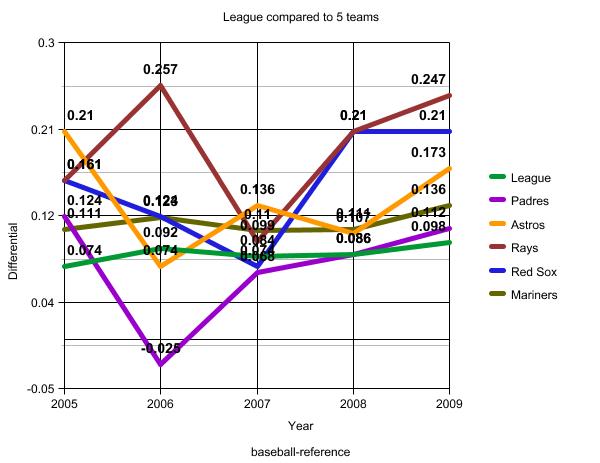
Here’s the second graph from Jon T. Intern, plotting the Padres, Astros, Rays, Red Sox and Mariners. Why those teams? Mostly more randomness.

I picked the Padres and Mariners because of their reputations for having pitcher’s parks, the Astros because they have a stupid, ridiculous hill in center field, the Rays because they play on turf, and the Red Sox because of its peculiar dimensions.

Looks like more noise to me. The Padres are the first team here to have played to a negative home-field advantage, back in 2006:

Home field advantage, random teams

post icon

Root, root, root for the home team

By Ted Berg on Oct 09, 2009, 1:04 pm

Harold Reynolds, on the MLB Network earlier this week, suggested that the Twins have the best home-field advantage in all of sports.

Just in terms of baseball, that seems to make a lot of sense. After all, the Metrodome features two unusual characteristics — artificial turf and a white roof — that could give fits two an unfamiliar team. (Granted, all Major Leaguers have played on turf at some point, but not with the frequency of the Twins, Blue Jays and Rays.)

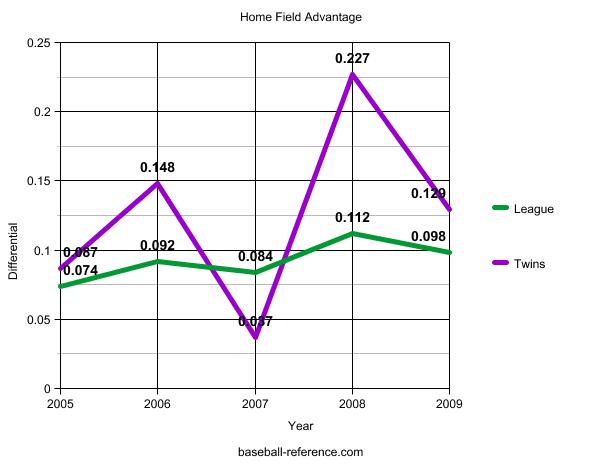
Anyway, the comment intrigued me, and I had an intern available to me with nothing else to do, and I love graphs. So, thanks to Jon T. Intern, here’s the differential between home winning percentage and road winning percentage for the Twins and the entire league over the last five seasons:

Twins vs. league average, home field advantage

So, by this relatively unscientific and totally imprecise method, the Twins have played to a better-than-average home-field advantage in four of the last five seasons. Is that significant?

Maybe, but I’m skeptical. It looks, to my untrained eye, like the whims of randomness and sample size.

Jon is working on another graph charting a bunch of other teams, ones that — off the top of my head — I thought might demonstrate a home-field advantage. Plus the Mets and Yankees, just because.

post icon

I won’t eat crow (unless it’s breaded and fried)

By Ted Berg on Oct 09, 2009, 11:01 am

People keep asking me to eat crow for bashing the Jeff Francoeur deal when it happened, and I’m still not willing to.

I’ll admit this: Francoeur outperformed Ryan Church for the remainder of the 2009 season, so in that sense, it worked out for the Mets. But I maintain that Church — though not worth a ton — should have had more value than Francoeur when he was dealt, and if the Braves were as eager as they should have been to part ways with Francoeur, the Mets should have been able to get him for less.

Don’t try to tell me they couldn’t have used Church, injury-prone and unspectacular though he was, over the course of the last few months of the season.

As for Francoeur, yes, he did a fine job for the Mets, hitting .311 with a .338 OBP and a .498 SLG in his 308 plate appearances. And even though he barely ever walked, it’s true that — as many have pointed out — if he could sustain that type of performance over a full season he’d be worth keeping around in 2010.

The problem is, it’s not at all likely he can. Players cannot reasonably hope to maintain an OPS of .836 — Francoeur’s final Mets line — without taking pitches way more frequently than Francoeur does. That’s the issue.

I Twittered about this a couple of weeks ago, and someone responded that both Carlos Lee and Pablo Sandoval have. It’s true that neither is exactly a paragon of patience, but Lee has walked in 7.3% of his career plate appearances and Sandoval has walked in 7.1%.

Francoeur walked in 3.6% of his plate appearances with the Mets, or about half as frequently as Lee and Sandoval.

For a quick and dirty reference point, I searched baseball-reference.com’s play index for seasons in which players got at least 500 at-bats while walking 30 or fewer times and maintaining an OPS+ above 110, the Major League average for right fielders.

Only 17 guys have done it in the past 20 years, and only Andre Dawson and Dante Bichette have done it twice.

The idea is that pitchers and scouts are smart people, and will learn better than to throw you anything good to hit once you’ve proven you’ll swing at most pitches.

Of course, Francoeur wasn’t exactly facing anyone new when he switched teams in the same division, so it’s a bit puzzling that the change of scenery did seem to affect him so positively.

So maybe Francoeur really just needed to get out of Atlanta, and will somehow maintain his .300+ batting average and decent production moving forward. As a Mets fan, I really hope that happens, and I’ll gladly sit down to a nice big plate of crow if it does.

The odds are strongly against him, though, so banking on it to the tune of the rumored three-year, $15 million contract extension would be shortsighted at best.

post icon

Items of note

By Ted Berg on Oct 09, 2009, 9:35 am

Sam Page of Amazin’ Avenue drives home a point I try to make all the time: labeling starting pitchers by rotation slot is pointless and unnecessary. Teams should just get the five best starters they can.

One of the biggest developments of the playoffs, I think, has been the exposure of Chip Carey as bad. I don’t get it: He’s so clearly unqualified for the job, how ever did he get it? Also, I feel like he’s dragging poor Ron Darling down.

Keyshawn Johnson has unmitigated gall to suggest that Braylon Edwards needs to focus on what’s on the field.

Carlos Gomez feels bad for the Mets. He’s not alone.

Ladies, gentlemen and Hoyas: We have a Michael Sweetney sighting.

If an unauthorized sequel to Catcher in the Rye was enough to make J.D. Salinger poke his head out and say, “stop that,” the Daily News’ back page today would probably really bother him, if only he subscribed to newspapers:

Mmm... pie.

Mmm... pie.