
It turns out Babe Ruth is buried about a mile from my house.
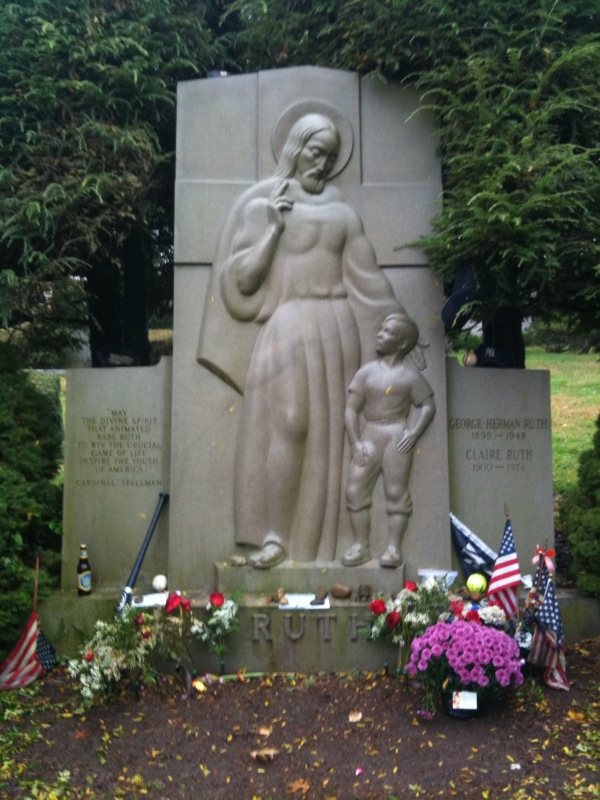
The rain washed away my plans to play baseball in Brooklyn today, so I had nothing better to do than go check out the Bambino’s grave. It looks like this:
At wakes and funerals, people often nod to the coffin and say things like, “It’s hard to believe he’s in there,” or, if it’s an open-casket affair, “He looks so good.”
But he’s not in there. And that’s not him that looks good. Those are merely the flesh and bones that he once inhabited. The person you knew was something that lived and breathed and thought and loved and miraculously somehow operated without batteries. That thing in the casket does none of those things. He is gone. Maybe to somewhere else, maybe to nowhere at all, but certainly not here. Kaput. Adios. So it goes.
I recognize that some people feel otherwise, and I certainly respect their right to pray over the caskets and visit the graves of their lost loved ones. But to me, cemeteries are only repositories for human bodies that are no longer of use to their owners, and vast reminders of our own mortality.
Ruth’s grave, though, feels different. Ruth’s grave is a reminder of the human potential for immortality.
It is large but unspectacular, featuring an engraving of Jesus guiding a small child flanked on the right by the names of Ruth and his wife, Claire, and on the left by an epitaph from Francis Cardinal Spellman. Around its base today were letters from fans, baseballs, Yankees hats, prayer cards and some news clippings about the current Yankees club. Against the stone leaned a bat, a 34-inch toothpick compared to the 54-ounce job Ruth swung. And someone left an unopened bottle of Sam Adams Summer Ale, because if the Babe were around today he’d certainly thirst for a beer with hints of lemon zest.
Standing there in the rain, I felt moved, maybe as much as I ever have been by a gravesite. Not toward sadness or anything like that. Toward something more akin to amazement. I kept thinking: “Holy crap, Ruth is down there. Babe Ruth. The Babe Ruth.”
On one hand, it’s oddly equalizing. Here lies Babe Ruth: 714 home runs, a 1.164 career OPS and a six-foot box. Same as the rest of us, really.
On the other, it’s wholly mesmerizing. To someone of my generation, it’s difficult to believe Babe Ruth actually existed. He died just a few weeks after my parents were born. Even my grandparents only would have caught the downside of his prime, and they passed away before I ever thought to ask them about him. Babe Ruth stands more like a mythical figure, a person whose existence we have some evidence of but whose awesomeness we can never fully comprehend.
And some parts of him are in there. They’re down in the ground, a few feet deep, not a mile from my house.
Is there really some of Ruth’s DNA somewhere not too far below where I just stood? Should that be exhumed? Could we clone Babe Ruth?
And what would happen if that happened? Could Ruth dominate current Major League pitching the way he dominated Major League pitching of the 1920s, back before the league had Black guys and Latin guys and Asian guys, and before weight training and before video scouting and before, ahh, nutritional supplements? Or would he just be some guy, some power hitting outfielder with a little bit of patience, like a Ryan Klesko or something?
Would Ruth, if he were around today, be chastised for playing the game the wrong way? Would he even play the game at all? Perhaps baseball was more the product of Ruth’s nurture than his nature. Maybe something about that Baltimore orphanage made it destined to produce the greatest hitter of all time.
Who knows?
What we know is that in 1915, Gavvy Cravath set the modern-era record with 24 home runs, and by 1920, Ruth had more than doubled it. And yeah, I know that 1920 marked the beginning of the so-called live-ball era when fresh equipment created a hitter’s paradise, but no one else hit more than 19 home runs that year. Ruth had 54.
Think of how crazy that must have looked. 54. Fifty-four home runs when the record — set by Ruth the year before — was 29. That’s like some player (a converted pitcher, no less), hitting 80 home runs next season, and then 150 the year after that. Mind-blowing.
And Ruth wasn’t just the game’s first great power hitter. We’re approaching a century since Ruth’s 1914 debut, and he remains the game’s greatest power hitter. Sure, some guys have hit more home runs in their career and some guys have hit more home runs in a season, but no one has even come close to Ruth’s .690 career slugging average.
Simply put: Babe Ruth was the Babe Ruth of being Babe Ruth.
And now what remains of him is busy not being Babe Ruth within walking distance of my house. So that’s cool. I imagine I’ll be back.
 Tedquarters
Great write up. Being from Thornwood originally I remember checking out his grave sometime while I was in high school. It was other worldly