
Rob Neyer’s usually spot-on, but I think he misses the mark a bit in his remarks on Jeff Passan’s recent rip-job of the Mets’ front office. Neyer and Passan agree that the Jason Bay signing, to paraphrase Neyer’s headline “continues a disturbing pattern.”
 If you read this site or my columns with any regularity, you know that I’m the first to criticize Minaya when he deserves it. In fact, I actually touched on a lot of the same themes Passan did in this column in August.
I’m certainly not out to excuse the club for refusing to spend above slot on draft picks. I still can’t, for the life of me, figure out what that’s about, unless it’s playing nice with the league in an effort to secure an All-Star Game at Citi Field.
But throwing money at Jason Bay, while perhaps shortsighted given the length of the deal, does not really do anything to hurt the Mets’ farm system. In fact, if there’s a year the Mets should be signing a Type A free agent, it’s this one, when their first-round draft pick is protected.
And citing Rubin’s work to rate the Mets’ farm system, as Neyer does, well, I don’t know. I’m skeptical. Organizational winning percentages are nice, I guess, but I don’t imagine they matter much, since it’s the performance of the prospects that matters more than the performance of the organizational guys who fill out most Minor League rosters.
The Mets’ Minor League rosters certainly lack depth. And they haven’t, under Minaya, produced a whole lot of top-flight Major League talent. Some warm bodies, for sure, but no All-Stars. That’s all true, and it’s certainly not good.
But for the first time in recent memory, the Mets now actually have a crop of intriguing prospects set for the higher levels of their farm system. Fernando Martinez, Ike Davis, Jonathon Niese and Josh Thole should all start the season in Triple-A. Brad Holt, Jenrry Mejia, Reese Havens and Kirk Nieuwenhuis should all start at Double-A Binghamton.
Granted, as a Mets fan, I’m probably overvaluing some of these guys. But all are still quite young and have performed well in the Minors, and so appear to have at least decent shots at becoming decent Major Leaguers.
And thus far this offseason, coming off an embarrassing 2009 campaign, Minaya has resisted the urge to trade any of them for a proven starting pitcher or an everyday catcher or a power-hitting first basemen.
I’d say, given the Mets’ history of quick fixes, that actually bucks the disturbing pattern.
Would I have signed Jason Bay to a four-year, $66 million deal with a vesting option? Probably not. Do I think he’ll help the Mets? Almost certainly. Would I choose him over Matt Holliday? Definitely not. Do I think his acquisition dooms them forever? Not at all.
The deal will probably hamstring the Mets financially down the road, especially since, in Minaya’s administration, they’ve had a whole, whole lot of problems grasping the concept of sunk cost.
But they have the advantage of playing in a huge market, so they can take one on the chin and recover if they can find cost-effective contributors elsewhere. And if they let their prospects develop into Major Leaguers, they’ll be doing just that.
Plus he’ll hit. It’s just not that disturbing.
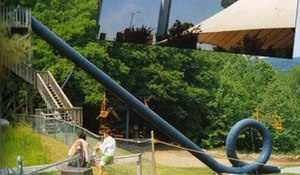 It does very much aim to make light of the horrible, horrible planning that led to said deaths, and I sincerely apologize if anyone out there lost a loved one due to the carelessness and downright stupidity involved in the creation of these rides. Death due to any circumstance — theme park mishap, bear attack, leprosy, whatever — is tragic and not funny, and please do not take this post to imply otherwise.
 TedQuarters: yo can I interview you?
 I’d still really like to reserve judgment until we know more, though. Specifically: the terms of the deal. By all accounts, it’s worth about four years and in the neighborhood of $66 million. By some accounts, it’s backloaded. By most accounts, it’s got a vesting option for a fifth year that will bring it to about $80 million.
 One of the actual knocks against Pelfrey from 2009 could be that his walk rate ticked up a tiny bit, from 2.87 BB/9 in 2008 to 3.22 BB/9 in 2009. Not a huge change and maybe not even a significant one, but not a good trend, for sure.
 Tedquarters