
“Hey Murphy, how about an autograph for a second baseman from a second baseman?” asked a kid behind a fence off Field 4 at the Mets’ Spring Training complex in Port St. Lucie, Fla. on Friday.
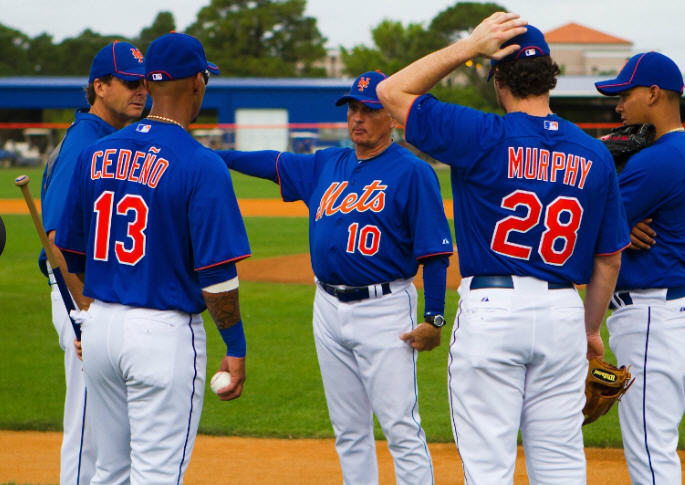 Daniel Murphy pivoted. “Which one of us is a second baseman?”
On Thursday, Murphy took hundreds of grounders at second. He stood on the infield grass as coaches with fungo bats hit slow rollers to him and his teammates. Then he moved back to the dirt for harder grounders, then to the lip of the outfield grass for sinking line drives. Of all of them, he botched only two: A consecutive pair of bouncers to his right late in the session, the first off his right foot, the second off the heel of his glove. He cleanly corralled the rest.
Every day here, after the Mets stretch around 10 a.m., Murphy practices his defense at second base: Taking relays from the outfield, covering first on bunts, negotiating the messy ballet of a rundown routine. Some days he works alone at the keystone, others he’s joined by Ronny Cedeno or Justin Turner. Ike Davis is always at first.
To a layperson, it’s easy to spot a difference in the way Murphy and Davis field. The lanky Davis is smooth: The ball heads his way and he is there, long right arm extending his huge first baseman’s mitt, gobbling up grounders and fluidly readying himself to throw. Even considering the confirmation bias that undoubtedly affects many empirical evaluations of Murphy’s defense, there are some particulars about the way Murphy approaches a grounder that are unique among those practicing in the group: Subtle extraneous movements, frenetic little steps in place — like Peyton Manning in the pocket.
Still, to layperson, it’s hard to see if it matters. Murphy gets to the balls. He makes the plays. His throws look sharp.
After the defensive drills, Davis and Murphy usually move to Field 7 for batting practice. In the cage, their styles are equally distinct. As the pitch comes in, Davis’ hands come down and loop back, he swings his front leg back and then kicks it forward, his bat following. It works for him; it produces what Jerry Manuel liked to call “easy power.”
Murphy keeps his stance wide. As the ball approaches, he rocks back ever so slightly, then twists his toe and unfurls on the ball. It doesn’t quite appear effortless, but optimized for efficiency. There’s little wasted motion, and Murphy slices and hooks line drives around the outfield.
But though the aesthetic differences between the Mets’ first and second basemen are stark on both sides of the ball, they are merely that: Aesthetic. The Mets and their fans seem confident that Davis will prove a strong offensive and defensive player if healthy in 2012. And they know Murphy will hit.
Many in the Mets’ fanbase and media are skeptical of Murphy’s ability to ever play second at the Major League level. Some, if pressed, will amount that he could produce more runs with his bat than he’ll cost with his glove, but they’ll never allow the possibility that he’ll become even an average fielder. The more impatient and dubious contend that if the club should entrust him with its starting second-base job, he’ll kill the Mets or get himself killed. And sometimes, instead of just ending the sentence and finishing a discussion, they’ll emphasize the way they’re doing both by saying or writing, “period, end of discussion.”
Only it won’t be the end of discussion. Right now, barring injury, Murphy appears ticketed to be the Mets’ starting second baseman come Opening Day.
Advanced defensive stats don’t have much value in small sample sizes, and Murphy doesn’t have enough time at any infield position for us to wean anything predictive from those metrics. But taken only as an indication of what has happened so far, and keeping in mind that UZR is fluky enough to say Carlos Lee was the second-best defensive left fielder in baseball in 2011, it’s worth noting that Murphy has played as a plus defender in the infield so far. Statistically speaking, there’s not much evidence yet that he’s as bad a fielder as everyone seems certain that he is.
When presented with that information, Murphy doesn’t seem struck one way or the other. Nor is he concerned about any skepticism outside the Mets’ clubhouse about his defensive ability.
“I’m more concerned about what my teammates think,” he says.
Davis, from his locker nearby, chimes in. “We haven’t made an error yet.
“I’m not happy with my defense now,” Davis says. “No one is; it’s Spring Training. If I still feel this way April 10, we’ve got a problem.”
Davis, supporting his teammate, means to imply that there’s a reason baseball players head south in February and spend seven days a week preparing for the regular season. Murphy is a professional athlete working every day at the position. This is the first spring he has spent exclusively at the keystone, a change he says he thinks is helping.
This isn’t a video game or the Army of McGwires scenario. It’s not just a matter of sliding a guy into a new position and docking his defensive rating some set number of points. Murphy appears to have the arm and hands for second base and the stats seem to like his range. He made some mistakes in his limited time at second in 2011, but none so egregious to damn his entire future at the position. He sustained injuries there two seasons in a row, but is working on the pivot and his footwork around the bag.
Maybe there will never be enough improvement, and the long-awaited Murphy-to-second experiment will implode in 2012. There will likely be some growing pains along the way, but maybe with practice Murphy will prove a capable defender and, as a young, strong-hitting, cost-controlled middle infielder, one of the Mets’ most valuable commodities. And maybe it will never look pretty, but it doesn’t much matter. All that matters is if it works.
Nothing can be concluded yet. This is the beginning of the discussion.
 Tedquarters